

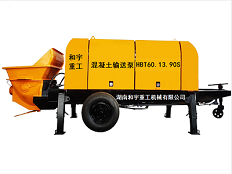
|
型号→ |
HBT60.13.90S |
HBT80.13.90SL |
HBT80.13.90SC |
HBT80.16.110S |
HBT80.16.110SC |
|
最大理论输送量(低压/高压) m³/h |
59/40 |
75/44 |
79/46 |
75/44 |
81/47 |
|
混凝土最大出口压力(高压/低压) MPa |
13/7.5 |
13/7.5 |
13/7.5 |
16/9.5 |
16/9.5 |
|
理论垂直输送高度 m |
270 |
270 |
270 |
330 |
330 |
|
理论水平输送距离 m |
1300 |
1300 |
1300 |
1600 |
1600 |
|
混凝土缸直径X mm |
φ200 |
φ200 |
φ200 |
φ200 |
φ200 |
|
动力品牌 |
电机 |
电机 |
电机 |
电机 |
电机 |
|
额定功率 |
90 |
90 |
90 |
110 |
110 |
|
主油泵品牌 |
力士乐 |
力源 |
川崎 |
力士乐 |
川崎 |
|
主油泵排量 ml |
190 |
214 |
224 |
260 |
280 |
|
长 mm |
6250 |
6250 |
6250 |
6250 |
6250 |
|
宽 mm |
1950 |
1950 |
1950 |
1950 |
1950 |
|
高 mm |
2300 |
2300 |
2300 |
2300 |
2300 |


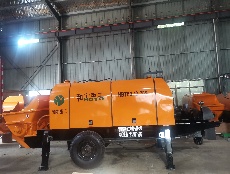
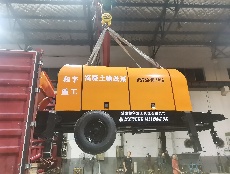
Large concrete conveying equipment, used for large-scale concrete conveying work such as high-rise buildings, highways, overpasses, etc.
Composed of a pump body and a conveying pipe. According to the structural form, it can be divided into piston type, extrusion type, and water pressure diaphragm type. The pump body is mounted on the chassis of the car, and then equipped with a stretchable or foldable fabric rod to form the pump truck.
Types: Divided into trailer concrete pumps, vehicle mounted pumps, and pump trucks according to structure and purpose, and divided into electric concrete delivery pumps and diesel powered concrete delivery pumps according to power type. Performance characteristics of concrete conveying pump
1. Adopting a triple pump open system, the hydraulic circuits do not interfere with each other, and the system operates.
2. It has a reverse pump function, which is conducive to timely elimination of pipe blockage faults and can be stopped for short periods of time to wait for materials.
3. Adopting advanced S-tube distribution valve, it can automatically compensate for wear clearance and has good sealing performance.
4. Adopting wear-resistant alloy eyeglass plates and floating cutting rings, with a long service life.
5. The long stroke material cylinder extends the service life of the material cylinder and piston.
6. Optimized hopper design for easy cleaning and better suction performance.
7. Automatic centralized lubrication system ensures effective lubrication during machine operation.
8. Equipped with remote control function, the operation is safer and more convenient.
9. All components comply with national standards and have good interchangeability.
The second generation pumping technology of concrete conveying pump: fully hydraulic control reversing technology
The first generation of pumping technology: electric control reversing technology, PLC controls solenoid valve reversing to achieve alternating reversing of pumping and S-pipe distribution.
The machine assembly is simple and the production cost is low, but the electrical control is complex, and the failure rate and maintenance cost are extremely high, which easily delays the project schedule and is the biggest drawback.
The second generation pumping technology: hydraulic reversing technology, which relies entirely on changes in the hydraulic signals of the main cylinder and the distribution small cylinder to achieve action reversing.
1. Concrete pumping and S-pipe distribution do not require the involvement of PLC electrical components, resulting in lower failure rates, more reliable control, and greatly improved product lifespan.
2. The fully liquid control technology transfer pump has no constant pressure pump, no PLC in the control box, no nitrogen storage tank, and no proximity switch at the water tank. Its structure is simple and maintenance costs are greatly reduced.
2) Before starting the homework, an inspection should be carried out to confirm that the electrical equipment and instruments are normal, the switch buttons and handles of each part are in the correct position, the fastening points of the mechanical parts are firm and reliable, the tightness of the chains and belts meets the specified requirements, and the transmission parts are operating normally.
3) The joints of concrete conveying pipes should be tightly sealed, and the pipe clamps should be firmly connected. A horizontal pipe with a check valve should be installed no less than 10m in front of the vertical pipe, and it is strictly prohibited to directly connect the vertical pipe to the output port of the concrete delivery pump.
4) When unblocking blocked pipelines, surrounding personnel should be evacuated. Before disassembling and cleaning the pipeline, a reverse suction method should be used to remove the pressure of the conveying pipeline. It is strictly prohibited to expose the pipe mouth to people during disassembly.
5) Do not remove the hopper grille and other safety devices during homework. Do not climb or ride on the conveying pipeline, do not put your hands into the valve body to work, and it is strictly prohibited to dismantle the pipeline during pumping.
6) When cleaning pipelines, operators should leave the pipeline outlet and bend joint. When cleaning pipelines, there should be no people or equipment within 10 meters of the pipeline outlet.
7) After completing the task, depressurize the hydraulic system and return all control switches to their original positions.
Operation of concrete pump
(1) The particle size of sand and gravel, cement grade, and mix proportion should meet the mechanical performance requirements of the pump according to the factory instructions.
(2) The parking brake and locking brake of the pumping equipment should be used simultaneously, the tires should be wedged tightly, the water supply should be normal, and the water tank should be filled with clean water. There should be no debris in the hopper, and all lubrication points should be lubricated normally.
(3) The bolts of each part of the pumping equipment should be tightened, the pipeline joints should be tightly sealed, and the protective devices should be complete and reliable.
(4) At the beginning of each operation, adjust the handle, handwheel, control rod, plug, etc. to the correct position. The hydraulic system should be normal and leak free.
(5) Prepare cleaning tubes, cleaning supplies, and other related equipment. Before starting the homework, the pipeline must be lubricated with cement mortar prepared according to regulations. Unrelated personnel must leave the pipeline.
(6) The legs should be fully extended and firmly supported, and the fabric rod should not be started until it is fixed. The fabric rod can only rotate after raising the bracket. When extending the fabric rod, it should be done in sequence. It is strictly prohibited to use fabric poles to lift or drag objects.
(7) When the fabric rod is fully extended, it is strictly prohibited to move the vehicle body. When moving during homework, the upper fabric rod should be folded and fixed, and the moving speed should not exceed 10km/h. The fabric rod shall not use pipes with a diameter exceeding the specified limit, and the installed wheel pipes shall be fastened with anti slip safety ropes.
(8) Various instruments and indicator lights should be monitored at all times, and any abnormalities should be promptly adjusted or dealt with. If there is a blockage in the conveying pipe, reverse operation should be carried out to return the concrete to the hopper, and if necessary, the pipe should be removed to eliminate the blockage.
(9) When the pumping system is under pressure, no conveying or hydraulic pipelines should be opened. The safety valve of the hydraulic system must not be adjusted arbitrarily. The accumulator can only be filled with ammonia gas.
(10) After the homework, all the concrete in the hopper and pipeline must be discharged, and then the pump, hopper, and pipeline must be cleaned. When washing the pipeline with compressed air, no one shall stand within 10 m in front of the outlet end of the pipeline, and a metal basket shall be used to collect the washed foam rubber and gravel particles.
(11) It is strictly prohibited to use compressed air to flush the fabric rod piping. The folding and shrinking of the fabric rod must be carried out in sequence.
(12) All parts of the control switch, adjustment handle, handwheel, control sweat, plug, etc. should be reset. Unloading of hydraulic system.
Harbin concrete pump Changchun concrete pump Shenyang concrete pump Beijing concrete pump Tianjin concrete pump Shijiazhuang concrete pump Zhengzhou concrete pump Jinan concrete pump Taiyuan concrete pump Xi'an concrete pump Yinchuan concrete pump Xining concrete pump Lanzhou concrete pump Urumqi concrete pump Lhasa concrete pump Shanghai concrete pump Nanjing concrete pump Hangzhou concrete pump Fuzhou concrete pump Hefei concrete pump Nanchang concrete pump Wuhan concrete pump Changsha concrete pump Chongqing concrete pump Chengdu concrete pump Guizhou concrete pump Kunming concrete pump Nanning concrete pump Guangzhou concrete pump Haikou concrete pump Taipei concrete pump Shenzhen concrete pump
Previous : 超细尾矿充填的新路径与环境效益分析
Next : Industrial filling pump